
-
Literary Theory [Internet Encyclopedia of Philosophy]
- we find an early attempt to theorize the position of African-Americans within dominant white culture through his concept of “double consciousness,” a dual identity including both “American” and “Negro.” Dubois and theorists after him seek an understanding of how that double experience both creates identity and reveals itself in culture. Afro-Caribbean and African writers—Aime Cesaire, Frantz Fanon, Chinua Achebe—have made significant early contributions to the theory and practice of ethnic criticism that explores the traditions, sometimes suppressed or underground, of ethnic literary activity while providing a critique of representations of ethnic identity as found within the majority culture
-
Formalism and New Criticism
“Formalism” is, as the name implies, an interpretive approach that emphasizes literary form and the study of literary devices within the text. The work of the Formalists had a general impact on later developments in “Structuralism” and other theories of narrative. “Formalism,” like “Structuralism,” sought to place the study of literature on a scientific basis through objective analysis of the motifs, devices, techniques, and other “functions” that comprise the literary work. The Formalists placed great importance on the literariness of texts, those qualities that distinguished the literary from other kinds of writing. Neither author nor context was essential for the Formalists; it was the narrative that spoke, the “hero-function,” for example, that had meaning. Form was the content. A plot device or narrative strategy was examined for how it functioned and compared to how it had functioned in other literary works. Of the Russian Formalist critics, Roman Jakobson and Viktor Shklovsky are probably the most well known.
- Formalist adage that the purpose of literature was “to make the stones stonier” nicely expresses their notion of literariness. “Formalism” is perhaps best known is Shklovsky’s concept of “defamiliarization.” The routine of ordinary experience, Shklovsky contended, rendered invisible the uniqueness and particularity of the objects of existence. Literary language, partly by calling attention to itself as language, estranged the reader from the familiar and made fresh the experience of daily life.
- so designated as to indicate a break with traditional methods, was a product of the American university in the 1930s and 40s. “New Criticism” stressed close reading of the text itself, much like the French pedagogical precept “explication du texte.” As a strategy of reading, “New Criticism” viewed the work of literature as an aesthetic object independent of historical context and as a unified whole that reflected the unified sensibility of the artist. T.S. Eliot, though not explicitly associated with the movement, expressed a similar critical-aesthetic philosophy in his essays on John Donne and the metaphysical poets, writers who Eliot believed experienced a complete integration of thought and feeling. New Critics like Cleanth Brooks, John Crowe Ransom, Robert Penn Warren and W.K. Wimsatt placed a similar focus on the metaphysical poets and poetry in general, a genre well suited to New Critical practice. “New Criticism” aimed at bringing a greater intellectual rigor to literary studies, confining itself to careful scrutiny of the text alone and the formal structures of paradox, ambiguity, irony, and metaphor, among others. “New Criticism” was fired by the conviction that their readings of poetry would yield a humanizing influence on readers and thus counter the alienating tendencies of modern, industrial life
- regard bears an affinity to the Southern Agrarian movement whose manifesto, I’ll Take My Stand, contained essays by two New Critics, Ransom and Warren. Perhaps the enduring legacy of “New Criticism” can be found in the college classroom, in which the verbal texture of the poem on the page remains a primary object of literary study.
- focus on the representation of class conflict as well as the reinforcement of class distinctions through the medium of literature. Marxist theorists use traditional techniques of literary analysis but subordinate aesthetic concerns to the final social and political meanings of literature. Marxist theorist often champion authors sympathetic to the working classes and authors whose work challenges economic equalities found in capitalist societies.
- in that Euro-American imperialism and colonization in the last four centuries, whether external (empire) or internal (slavery) has been directed at recognizable ethnic groups: African and African-American, Chinese, the subaltern peoples of India, Irish, Latino, Native American, and Philipino, among others. “Ethnic Studies” concerns itself generally with art and literature produced by identifiable ethnic groups either marginalized or in a subordinate position to a dominant culture. “Postcolonial Criticism” investigates the relationships between colonizers and colonized in the period post-colonization. Though the two fields are increasingly finding points of intersection—the work of bell hooks, for example—and are both activist intellectual enterprises, “Ethnic Studies and “Postcolonial Criticism” have significant differences in their history and ideas.
- the forefront of the theoretical scene first as feminist theory but has subsequently come to include the investigation of all gender and sexual categories and identities. Feminist gender theory followed slightly behind the reemergence of political feminism in the United States and Western Europe during the 1960s. Political feminism of the so-called “second wave” had as its emphasis practical concerns with the rights of women in contemporary societies, women’s identity, and the representation of women in media and culture.
- Feminist gender theory is postmodern in that it challenges the paradigms and intellectual premises of western thought, but also takes an activist stance by proposing frequent interventions and alternative epistemological positions meant to change the social order. In the context of postmodernism, gender theorists, led by the work of Judith Butler, initially viewed the category of “gender” as a human construct enacted by a vast repetition of social performance.
-
Thursday, February 9, 2012
Literary Theory [Internet Encyclopedia of Philosophy]


Wednesday, February 1, 2012
Saturday, January 28, 2012
Saturday, January 7, 2012
Saturday, December 10, 2011
Friday, December 9, 2011
Saturday, December 3, 2011
Friday, August 19, 2011
Day 3 Yoho National Park
Yoho National Park is a small national park next to Banff and Kootney. Although Yoho is only 1313 kilometers squared , the park is filled with scenic wonders. One of the highlights in my Yoho trip was Takakkaw Falls. This natural waterfall has a freefall of 254 meters. That makes Takakkaw Falls the third highest waterfall in Canada.
The word Takakkaw comes from the stony native expression, "it is wonderful". The Falls is wonderful. Even more amazing is that visitors are allowed to walk to the bottom of the falls. You can feel the water splashing in your face. You can also feel the cold water from the falls.
Yoho National Park's other highlight is Emerald Lake. Emerald lake is the largest of Yoho's 61 lakes and ponds. This lake has a 5.2 kilometer hiking trail. This lake like many of its brothers and sisters was formed by the damming effect of a eleven thousand year old glacial moraine. This moraine is located where the Emerald Lake Lodge now sits. The trail goes around the lake's perimeter, therefore, there is no real need to hike the whole distance. The first European to discover this lake was Tom Wilson. Tom Wilson discovered another lake which he gave it the same name. However, that lake is now Lake Louise. From a nature observer's point of view , you can enjoy the peaceful beauty of the lake. You will really enjoy the rock-flour colored lake for it evokes a happy memory. The mountains surrounding Emerald Lake are the Presidential Mountains. It is also surrounded by Mount Burgess and Wapta Mountain.
Another popular lake in Yoho is Lake O'Hara. This lake is located directly across the Continental Divide from Lake Louise. However, you will need a reservation in order to be taken up to the Lake. You could also hike up to the lake. It is just a fifteen kilometer hike. It would probably take you a few hours, but if you have a lot of time, then do it.
The word Takakkaw comes from the stony native expression, "it is wonderful". The Falls is wonderful. Even more amazing is that visitors are allowed to walk to the bottom of the falls. You can feel the water splashing in your face. You can also feel the cold water from the falls.
Yoho National Park's other highlight is Emerald Lake. Emerald lake is the largest of Yoho's 61 lakes and ponds. This lake has a 5.2 kilometer hiking trail. This lake like many of its brothers and sisters was formed by the damming effect of a eleven thousand year old glacial moraine. This moraine is located where the Emerald Lake Lodge now sits. The trail goes around the lake's perimeter, therefore, there is no real need to hike the whole distance. The first European to discover this lake was Tom Wilson. Tom Wilson discovered another lake which he gave it the same name. However, that lake is now Lake Louise. From a nature observer's point of view , you can enjoy the peaceful beauty of the lake. You will really enjoy the rock-flour colored lake for it evokes a happy memory. The mountains surrounding Emerald Lake are the Presidential Mountains. It is also surrounded by Mount Burgess and Wapta Mountain.
Another popular lake in Yoho is Lake O'Hara. This lake is located directly across the Continental Divide from Lake Louise. However, you will need a reservation in order to be taken up to the Lake. You could also hike up to the lake. It is just a fifteen kilometer hike. It would probably take you a few hours, but if you have a lot of time, then do it.
Wednesday, August 17, 2011
Choose the Canadian Rockies over Colorado
The Canadian Rockies consist of Banff, Jasper, Yoho, and Kootney National Parks. Even though the Canadian Rocky mountains are not as tall as the ones in the states, the Canadian Rockies have a scenic beauty that is incomparable to anything on Earth. From Edith Cavell's Angel and Cavell glaciers to the majestic Lake Louise, you can feel the harmony with nature.
Tuesday, August 16, 2011
Columbia Icefield
The Columbia Ice field is the highlight of the whole road. It is the largest ice field in the Rocky Mountains. It is approximately 200 kilometers squared. The people who work with the national parks will take tourists up to the Columbia Ice field for a price. The price is worth it . You can stand on the ice , but it is slippery. Also, remember to bring your sunglasses. When the sun shines on the glaciers, the glacier will reflect a lot of UV rays into your eyes. Those UV rays are harmful to your eyes.
According to the tour guide, some of the trees in the alpine and sub-alpine regions are over three hundred years old. However, the trees are really small. The soil on the alpine region of the Columbia Ice field is not fertile. Therefore, the trees cannot grow to be as tall as the evergreens in New Jersey.
Over millions of years, snow has accumulated and melted. However, due to Global Warming, the past decade has been the fastest decline in glacier ice. When the glaciers melt, it leaves a moraine. By definition, a moraine is a deposit of boulders, gravel, sand, and clay left on the ground by the glacier.
According to the tour guide, some of the trees in the alpine and sub-alpine regions are over three hundred years old. However, the trees are really small. The soil on the alpine region of the Columbia Ice field is not fertile. Therefore, the trees cannot grow to be as tall as the evergreens in New Jersey.
Over millions of years, snow has accumulated and melted. However, due to Global Warming, the past decade has been the fastest decline in glacier ice. When the glaciers melt, it leaves a moraine. By definition, a moraine is a deposit of boulders, gravel, sand, and clay left on the ground by the glacier.
Jasper Acronym
If you have been to Maligne Lake, then you know that Jasper is Just another way to extract revenue.
That is from the tour guide, Guy. He is a French Canadian. He has a little accent, so you can always ask him to repeat his previous statements. He has a good sense of humor.
His best story is at the end of the tour. So you should listen carefully. It is a hilarious story.
That is from the tour guide, Guy. He is a French Canadian. He has a little accent, so you can always ask him to repeat his previous statements. He has a good sense of humor.
His best story is at the end of the tour. So you should listen carefully. It is a hilarious story.
Monday, August 15, 2011
Lake Louise Photos
Hey Guys,
I am going to post some photos of the beautiful and awe-inspiring Lake Louise.


I am going to post some photos of the beautiful and awe-inspiring Lake Louise.


Moraine Lake
Before heading out to Lake Louise, you should also stop by Morine Lake. Morine Lake has a deep dark blue color due to the refraction of light off the rock flour. The rock flour is continually deposited into the lake. You can hike up a little hill and get a good view of the entire lake and its surrounding mountains. You should be careful because there is a section where the trail gets very steep.
Take a look at the pictures I took while I was at Morine Lake.


Take a look at the pictures I took while I was at Morine Lake.


Day 2 at Banff National Park
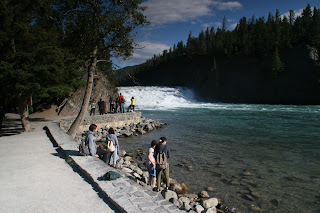
Before heading out towards Lake Louise Village, you should visit the Bow River Falls. It was at the Bow River Falls that Marilyn Monroe filmed her movie. The film was called River of No Return.




Cute Chipmunk on Sulphur Mountain
At the summit of Sulphur Mountain, I took a picture of a Chipmunk eating a nut.


Sunday, August 14, 2011
Jasper Tramway
The Jasper Tramway takes you up Whistler mountain. However, it only takes you half-way up. The rest of the way requires some hiking. The hike is both long and steep. Therefore, tourist who have bad legs might want to take more rests on the way. At the summit, you should take plenty of pictures because the view is terrific. You can see a beautiful mountain range with glaciers. The hike is about two hours to three hours. It might only take one hour if you are a track and field athlete.
Also , watch your step for the trail is not paved. There are lots of rocks and the trail is very steep. So watch your step, put away your camera, and look down at your feet. Whistler mountain is one of those mountains where people fall off of when they come down.
From the summit you can also see the town of Jasper. It is a small town located in the Valley. Every body know each other and Jasper's only industry is Tourism.
Also , watch your step for the trail is not paved. There are lots of rocks and the trail is very steep. So watch your step, put away your camera, and look down at your feet. Whistler mountain is one of those mountains where people fall off of when they come down.
From the summit you can also see the town of Jasper. It is a small town located in the Valley. Every body know each other and Jasper's only industry is Tourism.
Lake Maligne
Maligne in French means wicked. However, the view is certainly not wicked. It is a magnificent lake with glacier capped mountains surrounding it. It also has small islands. One of the islands is Spirit Island. You probably seen some of the photographs in Quebec and Ontario. Spirit Island is near the end of Maligne Lake. People who have visited Spirit Island call it the meeting place of the Gods.
Lake Maligne is pronounced as Mal-LEEN. This lake has a guided cruise from one end to the other end. The tour guide explains the history, culture, and geology of the lake. When the boat reaches Spirit Island, the tour guide gives everybody on the boat ten minutes to take pictures. You can either hike up and get a broader view of the end of the lake or you can make a left turn when you get off the boat. The narrow trail gives you a lower perspective of the nearby islands.
The tour guide shows his or her audience the old forest fire on the right hand side of the lake. He said that the mountain ecosystem on the right side is healthier than the mountain on the left because the sunlight can penetrate the forest floor. Since the mountain on the left hand side has not had a fire for 200 years, the trees are so dense that the sunlight cannot reach the forest floor. Therefore, many trees on that side of the lake are dying. Animals have to get to a higher altitude in order to survive.
Some of the animal sightings include grizzly bears and black bears. The difference of these two bears are simple. Grizzly Bears have a huge hump on their backs. That hump is pure muscle because they have to be able to swim from one side of the lake to the other side. Grizzly Bears also have claws while the Black Bear does not.
Lake Maligne is pronounced as Mal-LEEN. This lake has a guided cruise from one end to the other end. The tour guide explains the history, culture, and geology of the lake. When the boat reaches Spirit Island, the tour guide gives everybody on the boat ten minutes to take pictures. You can either hike up and get a broader view of the end of the lake or you can make a left turn when you get off the boat. The narrow trail gives you a lower perspective of the nearby islands.
The tour guide shows his or her audience the old forest fire on the right hand side of the lake. He said that the mountain ecosystem on the right side is healthier than the mountain on the left because the sunlight can penetrate the forest floor. Since the mountain on the left hand side has not had a fire for 200 years, the trees are so dense that the sunlight cannot reach the forest floor. Therefore, many trees on that side of the lake are dying. Animals have to get to a higher altitude in order to survive.
Some of the animal sightings include grizzly bears and black bears. The difference of these two bears are simple. Grizzly Bears have a huge hump on their backs. That hump is pure muscle because they have to be able to swim from one side of the lake to the other side. Grizzly Bears also have claws while the Black Bear does not.
Subscribe to:
Posts (Atom)